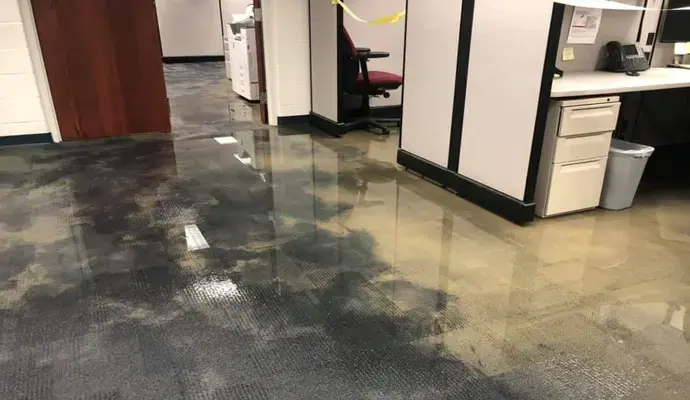
Mill Creek runs through Sharonville, and when it leaves its banks the water reaches buildings and parking lots that sit close to it. For a shop, warehouse or plant manager, the first day decides how much of the damage spreads into inventory, flooring and walls.
Key takeaways
- Mill Creek flood water is contaminated runoff, so a commercial space it enters is treated as a contaminated loss, not a clean water leak.
- Sharonville says 20 percent or more of its parcels fall inside the FEMA 100 year floodplain, so creekside exposure is a planning issue.
- NOAA notes that flooding along Mill Creek reaches the Sharonville area and affects numerous businesses.
- A manager's first jobs are safety, power and documenting the loss, in that order.
- Extraction, wet material removal and structural drying follow, and the business reopens when readings, not appearances, say the space is dry.
What Mill Creek does to Sharonville businesses
NOAA describes extensive flooding between Canal Road and Reading Road that reaches the Sharonville area of Mill Creek and affects numerous businesses. That is not a rare edge case; it is the creek's known pattern.
In May 2020 WLWT forecast a record Mill Creek crest of 18.17 feet at Evendale, against a prior record near 16.8 feet. That was a forecast, but it showed how high the creek can be expected to rise, with the worst flooding forecast along Mosteller, Kemper and Canal roads.
- At a Mill Creek level of 16.5 feet, Crescentville, Canal and Sharon roads flood.
- Businesses along the creek in Sharonville and Evendale then see flooded buildings and parking lots.
- USGS stream gauges on Mill Creek sit at Kemper Road and East Sharon Road in Sharonville.
The floodplain is part of the picture
Sharonville says 20 percent or more of its parcels fall inside the FEMA 100 year floodplain. The city runs a Flood Damage Reduction Ordinance and helps owners with Elevation Certificates and floodplain work permits.
A manager repairing a building after a loss should ask the city about floodplain work permits before opening walls or rebuilding, since the ordinance applies to work in that zone.
The mix of figures above should not be read as a promise about any one building. A parcel inside the floodplain is not certain to flood, and one outside it can still take water in a heavy rain.
What the numbers show is that creek flooding is a normal planning item for Sharonville owners, not a surprise.
The first day for a manager
The order below keeps people safe and keeps the insurance and repair picture clear.
- Keep staff and customers out of flooded areas and away from moving water in the lot.
- Do not enter a flooded space where electrical panels, outlets or equipment may be energized; ask the utility or an electrician about the power first.
- Photograph the water level on walls, shelves and equipment, with a date.
- Move inventory and records upward where that can be done safely and dry.
- Contact the insurer and the property owner, and keep a list of what was lost.
Keeping people safe in and around the lot
A flooded lot is a hazard before it is a cleanup. Creek water hides curbs, drains and debris, and a vehicle that looks passable can be swept or stalled.
A manager can post a simple perimeter, send staff home if the building is not safe and keep customers out until the water is gone and the power is cleared.
- Mark off flooded areas of the lot and the building entrances.
- Keep staff out of basements, loading docks and utility rooms that took water.
- Do not restart equipment that sat in creek water until it has been checked.
- Ask Duke Energy or an electrician about power to a wet building.
Extraction and what comes out
Creek water carries silt, so a flooded floor is often coated with mud as well as standing water. Pumps and truck mounted units pull the water off the floor, and the mud is cleared before it dries into the surface.
The work looks like the storm and flash flood cleanup a home needs, only at a larger scale, with more floor area and more fixtures to clear.
Speed matters because silt is abrasive and sticky. Once it dries on floors and fixtures it is harder to remove, and it traps moisture against the surface beneath.
Materials that rarely survive
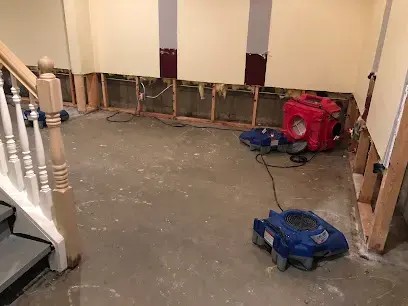
Porous items that took in creek water, such as carpet, pad, insulation and lower drywall, are normally removed. Hard surfaces such as concrete and tile are cleaned and treated.
- Carpet, pad and lower drywall are cut out.
- Concrete slabs are washed, then dried to a reading.
- Cabinets and shelving are checked for water behind the kickboard.
Stock, equipment and records
A manager should expect to sort stock into items that can be cleaned and items that cannot. Paper records and cardboard that sat in creek water are usually lost.
Drying a commercial building
After the water and silt are out, air movers and dehumidifiers run until moisture meters show the walls and floors have returned to normal. Commercial space is larger and has more hidden cavities, so the readings are taken in many places, not a single spot.
A business that needs to stay open can often section off the dry part of the building while the wet part is worked on. The commercial water damage team plans that split with the manager.
- Readings taken in wall bottoms, floors and ceilings.
- Dehumidifiers sized to the volume of the space.
- Rooms released for use as readings come back to normal.
Planning for the next creek rise
Because the exposure is known, a Sharonville business can prepare. Keep a short list of what must be moved first, store records above floor level and photograph the building when it is dry for a clean before and after.
The city's Sharonville hub and its flood ordinance are the places to ask about elevation and permits, while the restoration team handles the extraction and drying on the day of the loss.
- Keep inventory racks off the floor in low areas.
- Back up records away from the building.
- Know where the main shutoff and the electrical panel are.
Documentation that keeps the claim and the repair moving
Creek flooding can touch many parts of a business at once: the floor, the walls, the stock, the fixtures and the records. A clear record from the first day helps the insurer and the contractors work from the same picture.
The record is also what the city may ask for when floodplain work permits are involved.
- Dated photographs of the water on floors, walls, shelves and equipment.
- A list of damaged stock and equipment, with approximate values.
- Notes on when the water arrived and when it left.
- A written log of who was contacted and when.
Questions
Does Mill Creek flood Sharonville businesses often?
NOAA says flooding between Canal Road and Reading Road reaches the Sharonville area and affects numerous businesses, and at a creek level of 16.5 feet several roads flood and buildings and lots along the creek take water.
Is creek flood water treated as clean water?
No. Water from a creek carries silt and contaminants, so affected porous materials are removed and hard surfaces are cleaned and treated.
Do Sharonville properties sit in a floodplain?
The city says 20 percent or more of its parcels are inside the FEMA 100 year floodplain, and it runs a Flood Damage Reduction Ordinance with Elevation Certificates and floodplain work permits.
Can a business stay open during cleanup?
Sometimes. A dry section can be separated from the wet section while extraction and drying go on, depending on the extent of the water.
What is the first thing a manager should do after creek water enters a building?
Keep people out of flooded areas, treat the electrical power as live until cleared, and photograph the water level before moving anything.